Showing posts with label Geology. Show all posts

Monday, November 4

Yes, Please: Home Edition

With the start of November the holiday season is fast upon us... I know, I know, you're not ready.

Well, neither am I... Which got me thinking about guests... which led to thinking about entertaining... which led to thinking about having people over for dinner... which reminded me that since I previously had no formal dining table so I have no formal dining set up...

So I started looking for things online and ended up with this moldboard containing things far out of my monetary range but that I love. I already have a Wedgwood china pattern and crystal that I'm slooowly collecting after my wedding a few years ago so I don't really need to pick out those. So I went for the fun stuff.

I love rocks and geology and nothing is prettier to me than rocks and minerals so these malachite patterned chargers by Kim Seybert are so up my ally. I also really loved her vaguely sea inspires sparkly blue table runner and rock topped lucite napkin rings.

Everything else on my moodboard is from RabLabs. They make the most beautiful and amazing things! I'm totally in love with pretty much everything they make! They really utilize the minerals in a beautiful way that allows their true nature to shine through while giving them a beautiful function in the home. Agate chees plate, coasters, and utensils? Don't mind if I do! Crystal bowls and platters edged in sterling silver or gold? Yes, please!

I love everything on this table moodboard and while it's all pretty pricy... I figure it's a good place to start. Who knows, maybe by next year I'll actually be prepared for the holidays like a real adult... ;)

Kisses,

K

(All products by and available from Kim Seybert and RabLabs.)


Tuesday, January 8

A Study; Inspire Me Tuesday

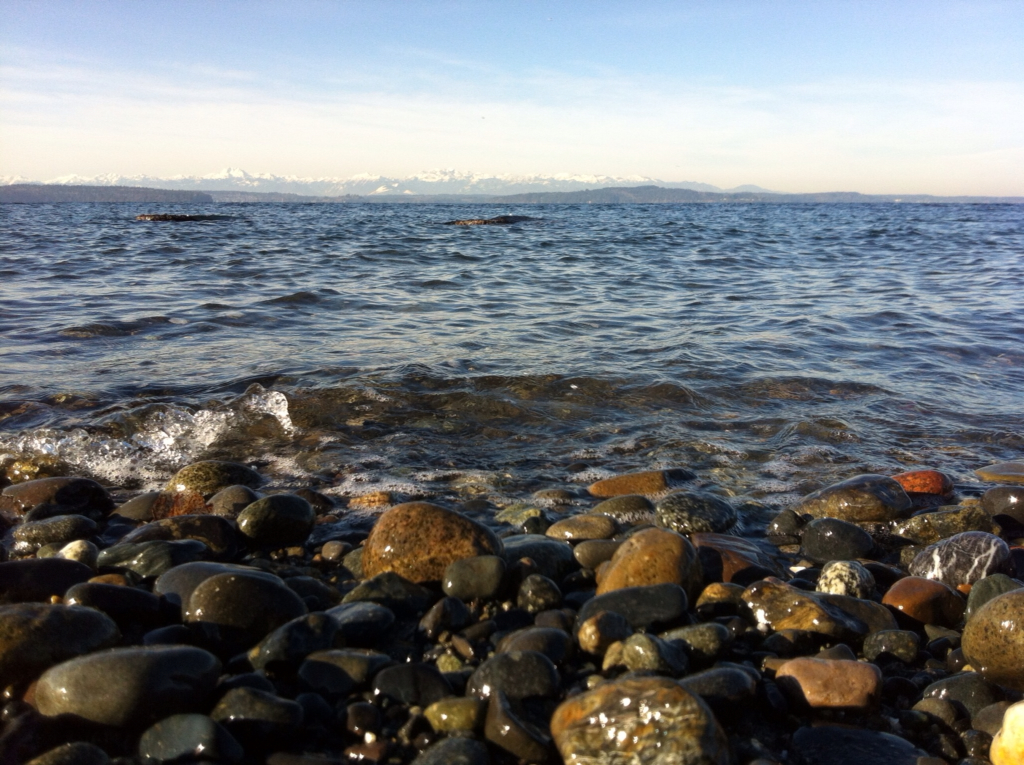
A study in pebbles on a clear cold winter's day.


Hope you enjoyed the colors and textures.

Kisses,

K

(All images created and owned by Krista Carson, Cinemagrams produced using Cinemagram, please ask permission for use.)


Friday, September 7

Mt St Helen's Continued 2

Once we left the ridge by the observatory we drove a bit further away and came across another awesome viewpoint.

You could really see the effects of the blast zone here. The blown over trees were mostly still intact in this area because, while this area was still devastated, the lava flow did not turn it to ash.

You see an completely uprooted tree here as well as the new life springing up around it.
We hiked a bit down a narrow mountainside trail and were rewarded with continuously fantastic views as we went. You can't really see how steep and tiny the trail is here... It was big enough to hike on but you really had to watch your footing on the loose slippery ash the trail was made of!

We were really enjoying ourselves and were debating whether or not to go "just a bit further" when the sun starting setting lower and we spotted a cougar about fifty yards away down slope...

So... We decided we better keep one eye on the cougar and head back but he disappeared into the brush pretty fast so no picture and no lingering (we couldn't tell which way it went!)... Even on the way back the trail afforded supe beautiful views though!

I was trying to show how steep it really was but with all the grass growing off the nutrient rich ash you really can't tell in the pics.

But, here is one last pic of this trail anyway. A pre-requisite shadow picture. My Husband and I have been taking them for years just about everywhere we go. (I even had a really special one I did as a gift for our anniversary back when we were dating in an art show once. This one wasn't so arty though, just for memories.)

Till the 'morrow...

Kisses,

K

(All images taken and owned by Krista Carson, please ask permission and credit when using.)

Wednesday, September 5

Mt St Helen's Continued

Our road trip out to Mt St Helen's was awesome! We saw so many great things I wanted to share a bunch more.
The volcano was was beautiful and the recovering landscape was amazing too.

This map shows where the photos were taken from at the Johnston Observatory Ridge.

Here's a photo of the current seismic activity. You can see Mt St Helen's reflected from outside the observatory window.

The information available inside was super great and interactive! If your into geology it's awesome! If your not, it helps explain what's going on in a fun way.

The volcano isn't supposed to erupt again anytime soon but is still active.
This is a sign discussing life before the eruption versus after.
In this photo you can see the two big grey chunks of granite off in the distance that actually used to be the top of the mountain. When it erupted they blew off.
Once Mt St Helen's lost her top the mountain ended up with a sort of flattened bowl left for a top.
Me and the volcano! I was super psyched!
It's hard to tell how massive everything actually is from the photos. There were actually some rather large elk in this photo but they could only be seen with magnification. (And there was steam rising out most of the time we were there, so cool!)
I thought this was a neat elevation chart.
To the left of the mountain is a giant pumice field you can hike out to.
There are remnants of ash flows left leading from the volcano throughout the valley. Some have small rivers running through them but overall they're pretty wide and mostly just, well, ash. It's neat to see life growing up around the remaining ash.
You can see felled trees all over the place that flattened out in a radial pattern from the blast zone. The reddish cast you see is actually small red flowers.

You can see a small river glinting in the sun in this ash flow off to the far left of St Helen's.

The Johnston Observatory Ridge is a fantastic lookout. I highly recommend making the drive out to it if your ever in Mt St Helen's National Monument!

Kisses,

K

(All images taken and owned by Krista Carson, please ask permission and credit when using.)

Saturday, August 18

Off The Grid

The Husband and I went on a spontaneous road trip the other day that took us completely out of cell range.

(Below is a screenshot of my poor iPhone trying to locate us, and signal.)

I won't tell you where we went just yet but it rocked my world!

Any guesses? More surprises to follow soon!

Kisses,

K

(All images by and owned by Krista Carson. Please ask permission for use and give credit, thanks!)


Monday, July 16

Mineral Mondays!

Imandrite:

Imandrite is a silicate in the Loverzerite group and a hybrid between nepheline syenite and Grauwacke, or an albitegranite. It is found in Khibinh massif, near Lake Imandra (its namesake), Kola Peninsula, and Russia.

Formula:
Na
12
Ca
3
Fe
3+
2
(Si
6
O
18
)
2
System:OrthorhombicHardness:5 - 5½
Member of:Lovozerite Group
It's silicate crystals have such pretty colorations but the more I look at it, it kind of reminds of a Christmas fruitcake... Lol... What do you think?

Kisses,

K

(Images and info via Web Mineral, Mindat, and the NGDI)


Tuesday, July 10

Inspire Me Tuesday

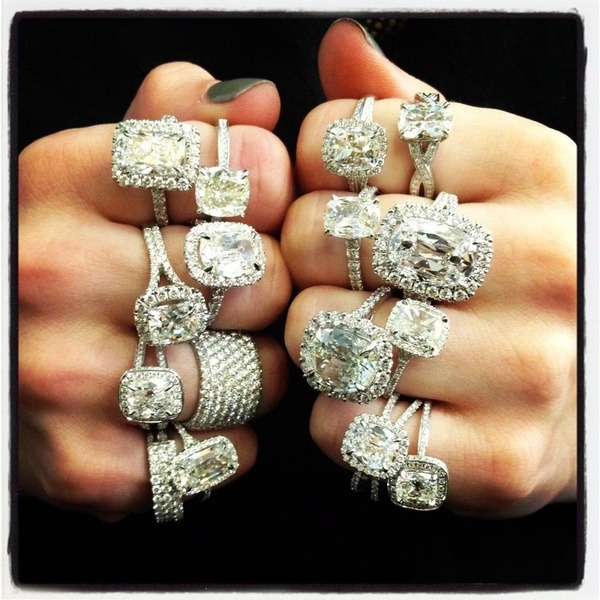
Here's to your sparkling style and personality! Hope you get out there and shine today!
Kisses,

K

(Image via ArtOfOverwhelm)


Monday, June 25

Mineral Mondays!

Gaspeite:
This rare stone takes its beautiful green hues from its Nickel content, it's naturally vibrant green is one of my favorites. It is only found in very few localities with the largest one in Western Australia. This location has long since been worked out, and the only Gaspeite available on the market now comes from small supplies collected many years ago.
Another stone similar in colour to Gaspeite is Mojave (Mohave) Turquoise, which is often marketed as being Gaspeite.

Formula:
(Ni,Mg,Fe)CO
3
System:HexagonalColour:Light green
Hardness:4½ - 5
Member of:Calcite Group
Name:After the type locality: Gaspé Peninsula, Lemieux Township, Gaspé-Ouest Co., Québec, Canada
Type Occurrence of Gaspéite:


Type Locality: New Jersey Zinc Exploration Co. roadcut, Mont-Albert, La Haute-Gaspésie RCM, Gaspésie-Îles-de-la-Madeleine, Québec, Canada

General Appearance of Type Material: Light green rhombohedral crystals, Spinel, Serpentine Group, Magnesite, Dolomite Annabergite

Associated Minerals at type locality:

Physical Properties of Gaspéite

Lustre: Vitreous, Dull

Colour: Light green

Streak: Green, yellow

Hardness (Mohs): 4½ - 5

Cleavage: Distinct/Good, Good {1011}

Fracture: Irregular/Uneven

Density (measured): 3.71(1) g/cm3

Density (calculated): 3.748 g/cm3

Crystallography of Gaspéite

Crystal System: Hexagonal

Cell Parameters: a = 4.621Ã…, c = 14.93Ã…

Ratio: a:c = 1 : 3.231

Unit Cell Volume: V 276.10 Ã…³ (Calculated from Unit Cell)

Kisses,

K

(Images and info via Cactus and Coyote, Entia Jewelry, Wikipedia, CMU, Mineral Atlas, Mindat)


Tuesday, June 19

Inspire Me Tuesday

The Paciffic Northwest is such an inspiring place to be. It never ceases to amaze me. There are so many naturally beautiful sights and sounds to experience. This weekend I had the pleasure of sharing one such moment with my husband.

We were out on a beach overlooking downtown Seattle as a summer storm approached. The air got a little bit thicker, darker, and the swiftening sky carried an intense marine smell on its winds. Suddenly, there were waves, significant ones for the Puget Sound, and into the quiet of the encroaching storm it was as if the waves began to sing.

They sang a song I had never heard before. A song that played against the rocky shore. A song of rushing and shushing. Of hurrying and reaching into the masses of pebbles and slipping away. Of mad dashes and whooshes....

It was a beautiful sound that spoke of land and sea and the power of nature. Those of you who grew up on rocky shoals have probably heard this siren song before. But growing up on gentle sandy beaches I had never heard even the largest of hurricane waves be able to sing this unique and beautiful language. It's power crashes onto soft cushioning sand.

For those who've never heard it, I wish l could share it with you. With all of you really. I'll work on uploading a video (always more to learn).

But in he meantime I hope you find a momment that moves you. I hope it as powerful, calming, lovely, and inspiring as mine is for me. I hope it helps you to translate a moment of peace and beauty that exists even amidst life's storms. It's there, somewhere, if you take a moment to breathe, look, and listen.

Kisses,

K

(Images property of Krista Carson)


Monday, June 11

Mineral Mondays!

Emerald: A variety of Beryl

A green gem variety of Beryl, highly sought after as a precious gem stone. The majority of the world's gem quality Emeralds come from the Muzo area of Colombia.
The colour in Emerald is caused by trace amounts of a chromophore such as Chromium or Vanadium.
Mineral Information on:
beryl


Chemical Group: silicate

Chemical Formula:
Be3Al2(SiO3)6


Color: emerald green, pale green, light blue, yellow, white, pink Streak: white


Luster: vitreous or resinous Transparency: transparent to subtranslucent


Hardness: 7.5 to 8 Specific Gravity: 2.63 to 2.80

Fracture: conchoidal to uneven

Cleavage: imperfect and indistinct


Crystal Forms: Hexagonal system
Crystals are usually 6-sided prisms capped with flat surfaces.

Mineral Associations: found in pegmatites

Identifying Characteristics: crystal shape and a pale-green color

Uses: as a gemstone; also as a source of the element beryllium

Occurrences: Colombia, Afghanistan, Brazil, Russia, Madagascar, SW Africa;
in the U.S. in Maine, New Hampshire, Connecticut, north Carolina, California

Toxicity: when-swallowed- when inhaled-

Additional Information:
If gemstone quality: green is emerald, bluish green is aquamarine,
pink is morganite, yellow is golden beryl or heliodor.


Kissses, 

K


(Images and info via minfind, Pinterest and Cochise)


Monday, May 28

Mineral Mondays!

A kiss on the hand can be quite continental...

But diamonds are a girl's best friend!
Formula:
C
System:IsometricColour:Colourless, yellowish to ...
Lustre:Adamantine, GreasyHardness:10
Name:From Greek "adamas", 'invincible'. First known use by Manlius (A.D. 16) and Pliny (A.D. 100).
Polymorph of:Chaoite, Graphite, Lonsdaleite

Diamond is the hardest natural substance known. It is formed deep in the mantle, and is only brought to the surface via kimberlite pipes, lamprophyres, eclogites and other rocks that originate deep within the mantle. It is also found in alluvial deposits, along with quartz, corundum, zircon and other minerals, derived from such rocks, and in certain meteorites.

The variety carbonado was suggested to form in stellar supernovae explosions (Garai et al., 2006), but this has been disputed by other authors.


Kisses,

K

(Images via Pinterest and info via Mindat)


Monday, May 14

Mineral Mondays!

Beryl (i.e. blue/ green goodness!):

Formula:
Be
3
Al
2
(Si
6
O
18
)
System:HexagonalColour:Green, blue, yellow, ...
Lustre:Vitreous, Sub-Vitreous, Waxy, GreasyHardness:7½ - 8
Member of:Beryl Group
Name:Possibly from the Greek "beryllos" which referred to a number of blue-green stones in antiquity.


Kisses,

K